
2026 CCA Colorado Ballot Measures Voter Guide
The Colorado Clergy Alliance represents over 160 multispiritual clergy organizing in love and solidarity with community, working for justice and peace, and honoring all that is sacred in creation.
These positions are offered as spiritual guidance for moral conscience, not as instruction from any single tradition, nor as a partisan directive.
General Election: Tuesday, November 3, 2026
This voter guide covers all state-wide ballot measures and is prepared by members of the Colorado Clergy Alliance.
For information about voting dates and information, go to Vote411.org.
If you have concerns about election protection you can call/text the Election Protection Hotline at 866-OUR-VOTE.
** 8 of the 14 measures are created and funded by a group called Advance Colorado. We’ve added next to each Advance Colorado ballot measure below. Advance Colorado has been building power through a coordinated, relentless ballot strategy; their financial backers are leveraging undisclosed billionaire and special interest funding to flood the ballot with multiple regressive tax and social policies. Learn more from the investigative report from the Colorado Times Recorder: www.whoisadvancecolorado.org
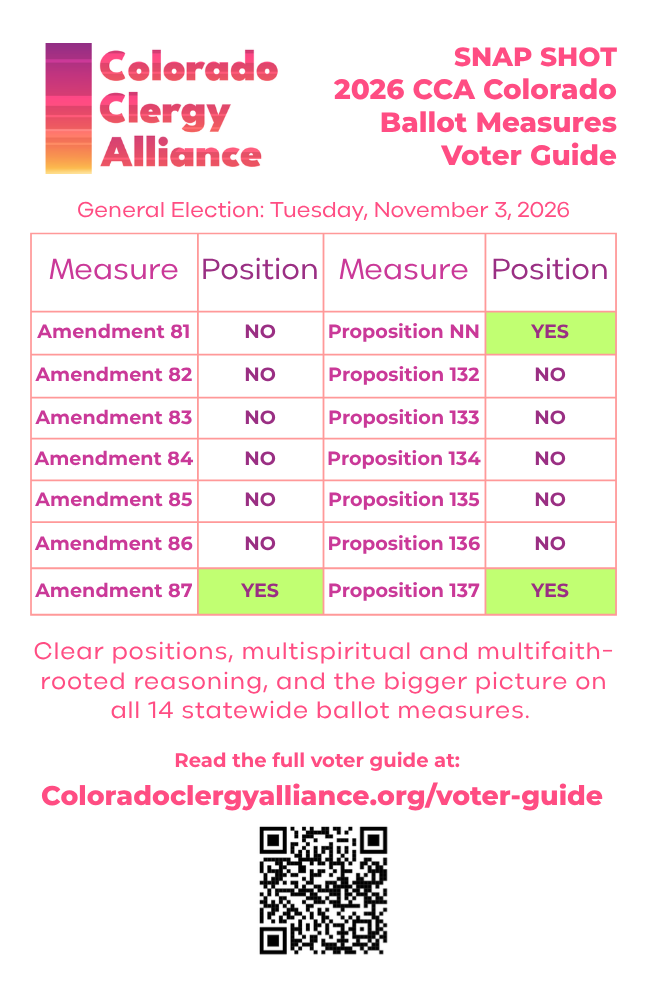
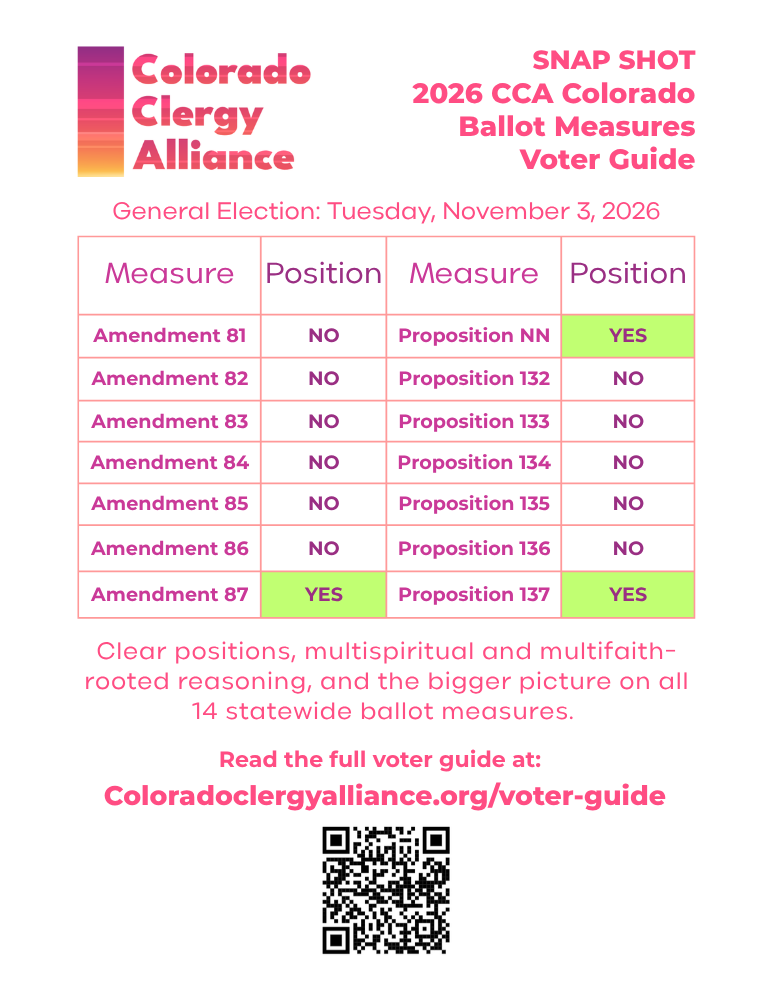
VOTE NO: Amendment 81**
Law Enforcement Reporting Requirements to Federal Authorities
Amendment 81 would require local law enforcement agencies to cooperate with the Department of Homeland Security, including ICE, by reporting people whose legal status they cannot quickly confirm. If enacted, this amendment would undermine due-process protections; expand ICE’s authority in Colorado by requiring local law-enforcement agencies to act on behalf of the federal government; place individuals and families at risk when they cannot immediately verify their citizenship status; erode trust in immigrant communities and discourage crime reporting; and expose all Coloradans—including U.S. citizens—to potential ICE targeting based on appearance or speech—racial and ethnic profiling.
A core tenet of our spiritual and faith traditions is the inherent dignity and worth of every person. Worth, dignity, and justice are neither defined by nor dependent on immigration status, documentation, race, ethnicity, or spoken language. We value the humanization of all people and oppose policies that dehumanize others. Our sacred texts call us to welcome, care for and protect those who are vulnerable. The Torah commands that the stranger be treated as the native-born and loved as ourselves (Leviticus 19:33–34). Jesus identifies himself with the stranger who is welcomed or turned away (Matthew 25:35). The Qur'an calls for kindness to “the near neighbor, the neighbor farther away” and “the traveler” (the neighbor who is a stranger and to the traveler (Surah AnNisā’ 4:36). Committed to the humanization of all people, and to a community where everyone can live safely and participate fully without fear, we are called to challenge unjust and discriminatory systems, not to hand them new tools that could further harm our neighbors.
Amendment 81 would require law enforcement to determine whether a person charged with a violent crime, or who has a prior felony conviction, is "lawfully present" in the United States, and to notify the Department of Homeland Security within 72 hours if the person lacks legal status or if officers remain unsure after trying to find out. The amendment does not say how officers should determine anyone's status, so people who cannot immediately prove citizenship, including U.S. citizens and lawful residents, could be reported to ICE, and decisions about whom to question could turn on appearance or speech. As Denver District Attorney John Walsh warned, the amendment "is a recipe for abuse and racial and ethnic profiling" (Colorado Newsline, September 14, 2026). Current Colorado law bars local law enforcement from participating in civil immigration enforcement, which allows police and prosecutors to assure victims and witnesses that coming forward will not expose them or their families to deportation. Amendment 81 would end that assurance, discouraging crime reporting and making every community less safe. It would also send more people into the custody of an agency facing ongoing scrutiny for detaining U.S. citizens, lawful permanent residents, medically vulnerable individuals, and DACA recipients without adequate due process; for aggressive stops, surveillance, and racial profiling that may violate the Fourth Amendment and separate families; and for detention conditions, including prolonged solitary confinement, severe overcrowding, unclean water, unsanitary food, and inadequate medical care, that may violate international prohibitions against cruel, inhuman, or degrading treatment.
VOTE NO: Amendment 82**
Right to Natural Gas
We urge a NO vote on Amendment 82, which would enshrine in the Colorado Constitution a right for gas distributors and utilities to sell natural gas, and for consumers to buy it, for cooking and heating in homes and businesses. Climate science teaches that caring for our environment, and therefore for one another and our health, requires a transition away from fossil fuels like natural gas, and this amendment would erect permanent limits on our ability to make that change as the need becomes clear.
This responsibility is grounded in our human role as stewards of the earth. Scripture tells of humanity placed in the garden "to till it and keep it" (Genesis 2:15), and Islam teaches humanity are Khalifah fi al-Ard, “stewards on Earth,” not owners, but a sacred trust—Amanah (Qur’an 2:30-Al-Baqarah). Our traditions also affirm our enduring capacity to learn from our mistakes and change course, what Jewish tradition calls teshuvah, which translates to “return,” and Christian tradition calls metanoia: turning toward a better way once we see more clearly. We are called to live in responsible care for all the life with which we share the earth, and we do not want constitutional limits on our freedom to change as a changing world requires.
The amendment’s language is brief, broad, and undefined, and legal experts say no one can predict with certainty how it would be used. Because it would be part of the constitution, it would override most laws limiting natural gas use, and the legislature could not fix or clarify it if problems arose; only another statewide vote could. Building codes that encourage electric heating and cooking could be challenged. More broadly, a bipartisan group of more than 50 legislators and candidates warns that oil and gas companies could sue state and local governments, arguing that safety inspections, pollution limits, or required distances between drilling sites and homes, schools, and playgrounds violate their new constitutional right. When lawmakers tried to pass a bill protecting public health and safety rules from such challenges, it was blocked in the final hours of the session. Colorado needs stronger tools to protect communities from pollution, not weaker ones. Neighbors of the Suncor refinery in Commerce City and North Denver, largely low-income communities that have lived for decades with smoke, odors, and toxic releases, know how hard accountability already is. Even after the largest air pollution settlement against a single facility in state history, residents are still turning to the courts to seek relief. We understand concerns about energy costs and choice, but a constitutional amendment protecting one fossil fuel is the wrong answer. It would tie the hands of state and local governments at the very moment our communities need the freedom to protect clean air, clean water, and public health, and to build the clean energy future our children will inherit.
VOTE NO: Amendment 83**
Constitutional Right to Hunt and Fish
We urge a NO vote on Amendment 83 because it would lock one approach to wildlife management into the Colorado Constitution, erecting barriers against future conservation efforts and opening the door to harmful practices Colorado has already rejected. As we care for all of creation, there are times we must adjust our behavior to protect animal populations and ecosystems, and this amendment would make that far harder.
Our traditions honor the bond between human beings and the rest of creation. Hunting and fishing have long sustained families and communities, and for many Indigenous peoples, hunting is a sacred relationship of reciprocity and respect. Our traditions also set limits on how we treat other creatures. Jewish law forbids tza'ar ba'alei chayim, causing needless suffering to living beings. Proverbs teaches that the righteous care for the lives of their animals (12:10). The Prophet Muhammad taught that a man who gave water to a thirsty dog was rewarded by God, because there is reward in kindness to every living being. When the companions asked, “Is there a reward for us in serving animals?”, the Prophet Muhammad, peace be upon him, replied: “In every living creature, there is a reward.” Buddhist and Jain traditions call us to ahimsa, non-harm toward all living beings. As a humanity called to responsible living with all creation, we honor a discipline that stays open to new insight and free to change our ways when we discern harm to the natural world. Our responsibility for all life must not be narrowed by the limited interests of any one group, or locked in place in a way that keeps us from learning and doing better.
Hunting and fishing are already legal and regulated in Colorado. Amendment 83 would go further, establishing a constitutional right to hunt, fish, and harvest wildlife "by the use of traditional methods," declaring hunting and fishing the state's "preferred means" of managing wildlife populations, and allowing the state to regulate these activities only when "necessary" for sound scientific conservation, public safety, or preserving hunting and fishing opportunities. In effect, it would change who decides the future of Colorado's wildlife. By placing hunting in the constitution, it would create precedent-setting barriers against future conservation efforts by voters, the legislature, and the courts, and even supporters describe making future wildlife ballot measures harder to pass as one of its purposes. Opponents warn that the language is dangerously vague. "Traditional methods" is undefined, raising the prospect of lawsuits to overturn practices Colorado voters have already banned, such as baiting and steel-jawed leghold traps. The "necessary" standard would invite costly litigation over future wildlife rules and could weaken the authority of state wildlife scientists. Naming hunting the "preferred" tool would place it above habitat restoration, relocation, fertility control, and non-lethal conflict management, even when those approaches would better serve declining or at-risk species. Supporters say the amendment would not change current rules and preserves the state's authority. But if that is true, the amendment is unnecessary, and once it is in the constitution, courts will interpret its words, not the intentions of its backers.
VOTE NO: Amendment 84**
Mail Ballot Voter Identification
Colorado has universal mail-in voting, with 92.2% of those who voted in 2024 choosing this method of voting over in-person voting. Amendment 84 would require voters to write the last four digits of their Social Security number or their driver's license or state ID number on their mail ballot envelope, and would prohibit counting any ballot until missing or mismatched information is corrected. To add an additional ID requirement to the ID requirement at registration is an unnecessary barrier to voting.
A call to communal care includes making sure everyone has access to express their voices within a democratic society. The Qur’an states Allah intends ease for you, not hardship (2:185 Surah Al-Baqarah), a principle that cautions against erecting new barriers where none are needed. Our traditions also honor the voices of those who might otherwise go unheard: the daughters of Zelophehad came before the whole assembly to claim their rightful share, and their voices changed the law (Numbers 27). Adding a secondary ID requirement would impact people who need or wish to vote by mail, and those hurdles fall hardest on elders, people with disabilities, students, and rural voters. As a commitment to all people expressing their vote, we cannot reduce their access on false premises of voter fraud.
The voter registration process already includes voter ID requirements: people provide a driver's license, state ID, or Social Security number when they register. Every mail ballot envelope must also be signed and checked against the voter's signature on file, a system election officials have called a gold standard. There is no mail-in ballot voter identification problem that needs to be addressed, as there is no evidence of a problem with the process to begin with. This amendment will create new problems, like preventing lawful ballots from being counted. Handwriting varies, and every number election workers must read and match is another chance for a lawful ballot to be rejected. Writing personal ID numbers on the outside of a ballot envelope could also put voters at risk of identity theft, and county clerks are still working out how the requirement would affect college students who may not have a Colorado license or know their Social Security number. The measure would cost state and local governments up to $2.5 million in its first year and up to $1.2 million every year after.
Vote NO: Amendment 85**
Plain Language Ballot Questions
Amendment 85 would require all state and local ballot questions to be written in plain language at no more than an eighth-grade reading level, and would prohibit any state law from requiring language in a citizen initiative's ballot title that interferes with that standard. While this may sound equitable, even democratic, the real purpose of this amendment is to dismantle mandatory fiscal disclosures that hurt conservative tax-cut initiatives. This means that Amendment 85 would make raising taxes on the wealthy harder than cutting taxes for the wealthy.
Our diverse spiritual and faith traditions call us to public representation of truth, not obscured half-truths dressed up as accessibility. The Qur'an warns “Do not mix truth with falsehood or hide the truth unknowingly.” (2:42 Surah Al-Baqarah), and the prophet Zechariah calls us to “Speak the truth to one another; administer sound and true justice in your courts” (Zechariah 8:16). When we create laws, the language we put before voters should, for the sake of truth, be as precise as possible. By omitting information or changing language to meet a certain age level standard for reading, we prevent voters from making an informed decision on the precise meaning of the law they are being asked to pass. CCA's commitment to the humanization of all people means trusting our communities with real information about how policy will affect their lives and their neighbors' lives — especially those most vulnerable to cuts in public services. We ground ourselves in traditions that name harm clearly, resisting the cultures of harm that prefer confusion to consent — and consent requires knowing what you're actually agreeing to. Reducing harm means equipping people with what they need to make informed decisions, not stripping away disclosure rules that help voters see who benefits and who pays. Accountability to our shared values means calling out when "plain language" is wielded as a tool for less transparency, not more — and standing with the low- and middle-income communities who bear the weight when tax cuts for the wealthy go undisclosed.
Colorado's ballots are genuinely hard to read, and we share the goal of making them clearer. But in recent years, Colorado has passed transparency laws requiring ballot titles for tax cuts to state how they would reduce funding for public services, and requiring income tax measures to show how they would affect people in different income brackets (Proposition GG, 2022). Amendment 85 would strip these mandatory disclosures, which make visible the cuts to public services that tax cuts would bring and who would benefit most. By forcing an 8th-grade reading cap and blocking statutory additions, the amendment would neutralize those disclosure rules. At the same time, the requirement that tax increases begin with "Shall taxes be increased" is written into the state constitution, so Amendment 85 would not affect it. Tax increases would still carry their warning, while tax cuts would lose theirs. The amendment also does not define "plain language" or say who decides whether a ballot question meets the standard, which could invite legal challenges to ballot language. The measure comes from Advance Colorado, the same group that opposed Proposition GG in 2022 and called the income-bracket table "meddling in the citizens initiative process."
Vote NO: Amendment 86**
Congressional Redistricting
There is a process in place to update district boundaries based on census data each decade, and updating district boundaries mid-decade without updated data opens the door to gerrymandering. But Amendment 86, which would require any mid-decade congressional map in Colorado to be approved by the independent redistricting commission and the Colorado Supreme Court, would bind only Colorado while other states continue to redraw their maps for partisan gain, weakening Colorado voters' voice in Congress rather than ending the gerrymandering crisis.
Throughout diverse sacred texts, when the voices of those marginalized by the empire were limited even more, prophets and disciples would rise up to ensure those voices could be honored. It is within our common commitment to all of humanity to allow their voices to be heard. Any act to suppress any voice is an act to deny their wisdom and insights to be shared. Our commitment is to fair representation for everyone, not to a rule that holds one state's voters to a standard others ignore, leaving Coloradans' voices diminished in the halls where decisions about all our lives are made.
Without updated data, redrawing districts opens the door to gerrymandering. When electoral district boundaries are redrawn to give one political party or racial group an unfair advantage in elections, it suppresses people's right to have an equal vote. Racial gerrymandering is prohibited under the 14th Amendment's Equal Protection Clause, and the Voting Rights Act was long the primary tool communities of color used to challenge maps that diluted their voting power. But in Louisiana v. Callais this April 2026, the Supreme Court narrowed that protection so sharply that a map now violates the Act only when there is strong evidence of intentional racial discrimination, allowing states to defend discriminatory maps by pointing to partisan goals. In dissent, Justice Kagan warned that the ruling leaves the Act's core protection "all but a dead letter." Districts are supposed to be drawn based on population-based criteria from the census so that our elected representatives actually represent the people in their district, not just the people like them or the people who will vote for them. This nationally coordinated effort by the Trump administration and Republicans to push states to redistrict in the middle of the decade is an unprecedented gerrymandering crisis. Texas redrew its congressional map in 2025 at President Trump's urging to gain as many as five Republican seats; Missouri, North Carolina, and Ohio followed, and California voters responded by approving a map expected to shift five seats toward Democrats. Amendment 86 would not stop any of this. Colorado already has strong protections: in 2018, voters approved Amendments Y and Z, creating independent commissions and banning partisan gerrymandering in our regular redistricting process. Amendment 86 would add a constitutional lock that applies only here, making it much harder for Colorado to respond to other states' actions and decreasing our state's voice at the federal level. Ending mid-decade gerrymandering requires a national standard that applies to every state equally, like the bipartisan TRUST Act introduced this month by Colorado Rep. Jeff Hurd, not a one-sided restriction that silences Colorado's voters while others redraw their maps.
Vote YES: Amendment 87
Graduated Income Tax
Because Proposition 136 is designed to block this measure's higher rates, and with them most of the new revenue, a YES on 87 needs a NO on 136 to stand.
Amendment 87 would replace Colorado's flat income tax for individuals and businesses with a graduated income tax, dedicate the new revenue to K-12 schools, health care, and early child care and education, and exempt that revenue from the state's constitutional revenue limit. It asks the wealthiest Coloradans and the highest-earning corporations to pay their fair share. Those with taxable income under $500,000, about 97% of Coloradans, would pay the same or slightly less. Higher tax rates would apply only to income above that $500,000.
Our traditions measure generosity by capacity, not by a single number applied to everyone. Jesus taught that "to whom much has been given, much will be required" (Luke 12:48). When the apostle Paul gathered support for struggling communities, he asked not that some be burdened so others are eased, but for a fair balance, pointing back to the manna in the wilderness: "The one who had much did not have too much, and the one who had little did not have too little" (2 Corinthians 8:13–15; Exodus 16:18). In Islam, zakat is a fixed annual obligation that applies only when a Muslim’s qualifying wealth reaches a minimum level. This structure inherently protects people with modest means from being burdened by zakat. Across our diversities, we share the conviction that a just community asks the most from those with the most. Our practice is to ask what people need and to stand with those most vulnerable right now: children in underfunded classrooms, families facing the loss of health coverage, and parents who cannot find or afford child care. A fair tax system is how a whole people practices mutual aid at scale.
A graduated tax works in brackets, and each rate applies only to the income within that bracket. Under Amendment 87, beginning with tax year 2027, the first $25,000 of taxable income would be taxed at 3.7%, income up to $100,000 at 4.2%, and income up to $500,000 at the current 4.4%. Above that, rates rise to 7.4%, 7.9%, and 8.4% for income over $1 million. For example, someone earning $600,000 pays the higher rate only on their last $100,000. Income from selling a primary home would continue to be taxed at the current 4.4%. About 64,000 people would pay more, and the measure would raise an estimated $2.7 billion a year. This is not a radical idea. Colorado itself had graduated rates until it switched to a flat tax in 1987. This amendment lets the state keep the new revenue rather than refunding it under TABOR, and it dedicates that revenue to schools, health care including replacing lost federal Medicaid funding from H.R. 1, “One Big Beautiful Bill Act of 2025,” and early childhood education.
Vote YES: Proposition NN
State Public K-12 Education Funding
This proposition allows Colorado's outdated revenue cap to be raised and uses funds already collected to support K-12 public education, increasing state investment in schools by 2% each year for the next ten years. This is done without raising taxes, by keeping revenue that would otherwise be refunded under TABOR.
Education is a valued practice within our diverse spiritual and faith traditions. It is how we ensure all can advocate for themselves, learn about the world they are a part of, and create a more just and caring future. The Torah calls us to teach our children diligently (Deuteronomy 6:7), Proverbs urges us to train children in the way they should go (22:6), and the Prophet Muhammad taught that seeking knowledge is an obligation upon every Muslim. Whatever the venue of education, our spiritual traditions support the care of learning for all people.
Education funding is currently connected to the Taxpayer's Bill of Rights (TABOR), which caps how much of the revenue the state already collects it can keep and spend each year, including on K-12 public education. Proposition NN raises that cap by the amount spent on K-12 education and begins to untether those funds from the limits set by TABOR. For more than three decades, this revenue cap has limited how much Colorado can invest in public schools, contributing to larger class sizes, educator shortages, and fewer resources for students. An independent study commissioned by the state found that Colorado's schools are underfunded by about $4 billion a year. Under Proposition NN, retained revenue would first reimburse local governments for revenue lost to the homestead property tax exemption, then fund K-12 education, specifically raising teacher pay and retention, lowering class sizes, supporting students with disabilities, and expanding career and technical courses, along with other programs that support children. An independent public audit would be required every year. The measure would reduce TABOR refunds by an estimated $136 million in 2026–27 and about $970 million in 2027–28, with amounts varying after that.
Vote NO: Proposition 132**
Penalties for Fentanyl Crimes
Proposition 132 would make possession of any amount of fentanyl a felony, require a mandatory minimum 8-year prison sentence for distributing or sharing any amount, and eliminate existing options to reduce penalties. This proposition is a "tough on crime" approach to drugs and addiction, which evidence shows does not work. The tactics of this proposition do not reduce drug use or sales, do not disrupt the drug supply, do not reduce overdose deaths and are projected to increase them, and do not expand access to treatment. Instead this proposition will cause more harm, increase the prison population, and risks directing our tax money to private, for-profit prisons.
We do not support expanding the prison industrial complex. It is inhuman, and not restorative, and we believe that individuals and communities can be restored to one another. Our spiritual and faith traditions call us toward restoration, not retribution. We believe every person struggling with addiction carries the same sacred worth as anyone else, and that a system built to punish rather than heal denies that humanity. The Prophet Muhammad, peace be upon him, said “There should be neither harming nor reciprocating harm” (Sunan Ibn Majah 2340 and al-Muwatta of Malik). This hadith is a core maxim in Islamic jurisprudence used to guide legal and policy decisions by prioritizing the prevention of harm. In the Gospel, we are taught “Love never wrongs anyone—hence love is the fulfillment of the Law” (Romans 13:10). Reducing harm is one of our core practices, and that means equipping ourselves and our communities with real strategies for safety, care, and recovery, not doubling down on approaches that research shows fail to save lives. We are called to be present with those most vulnerable right now: people using drugs, people in active addiction, people afraid to seek help. It causes harm and preventable deaths when policies make people more afraid to call for aid when someone overdoses.
Proposition 132 would make possession of any amount of fentanyl a felony, even for a first offense, and would impose a mandatory minimum 8 to 32-year prison sentence for distributing any detectable amount, with no distinction between someone selling a single pill and a large-scale trafficker. It would also raise penalties for people who did not know a substance contained fentanyl. The research is clear: neither increased arrests nor harsher criminal penalties for drug law violations reduce drug sales or drug use. What this kind of policy does deter is people seeking emergency medical help when someone overdoses, out of fear of prosecution. The Colorado Criminal Justice Reform Coalition projects that Proposition 132 would increase overdose deaths in Colorado by 41% and send nearly 900 more people to prison each year. The measure also eliminates existing options to reduce penalties and divert people to treatment. While it would allow some people convicted of low-level possession to have their felony vacated after completing treatment, it provides no dedicated funding for treatment despite carrying an estimated $68.2 million cost by its fifth year. Like the crack cocaine laws of the 1980s and 1990s, this measure would also disproportionately affect communities of color, not because people of color are more likely to use fentanyl, but because the policing used to enforce it has long been concentrated in those communities. Black and white Americans use illegal drugs at similar rates, yet Black Americans have been arrested and imprisoned for drug offenses at far higher rates, an injustice Congress itself acknowledged when it reduced the crack sentencing disparity in 2010. Mandatory minimums like these also drive the growth of a prison system that increasingly depends on private, for-profit companies. This year, Governor Polis asked lawmakers for hundreds of millions of dollars to open one or even two new prisons, and the state has turned to contracts with private prison companies to house people it cannot fit, a drain on taxpayer dollars that Proposition 132 would only accelerate. This is not a fentanyl solution; it is an expansion of incarceration that will disproportionately harm the very people the crisis has already devastated.
Vote NO: Proposition 133
Penalties for Human Trafficking of a Minor
Proposition 133 would change human trafficking of a minor for sexual servitude from a class 2 felony, which under current law carries a prison sentence of up to 48 years followed by five years of mandatory parole for those convicted, to a class 1 felony with a mandatory sentence of life in prison without parole or release. It does not get at the root cause of trafficking or care for those recovering from having been trafficked, and it risks sentencing survivors who were coerced into recruiting others to mandatory life in prison.
We are unequivocally committed to protecting children from exploitation and to caring for survivors. The act of repentance and redemption are also core to our spiritual and faith traditions. The prophet Ezekiel declares that God takes no pleasure in the death of the wicked, but desires that they turn from their ways and live (Ezekiel 33:11). Jewish tradition holds that the door of teshuvah, return, is never closed. To remove the possibility of parole and release goes against this belief. Doubling down on the punishment does not address the root causes of human trafficking and does not support those who are being trafficked.
The reasoning behind the statutory changes in proposition 133 is that the current sentence is not stopping human trafficking, and that moving it to life without parole will reduce human trafficking because traffickers can't repeat the act once released and will be deterred by the life in prison sentence. As we've seen with the "war on drugs," focusing on the punishment does not reduce the use or practice that is seen as criminal, and research on deterrence has found that the certainty of being caught deters crime more than the severity of punishment. The measure would also broaden the crime to include knowingly trading anything of monetary value to buy or sell sexual activity with a minor, and it would remove judges' ability to consider the circumstances of each case. The language also doesn't address that once someone is trafficked they can become a mechanism for trafficking others through forced roles of recruitment, isolation, and enticing. Current law provides an affirmative defense for victims who were forced or coerced into trafficking others, but survivors must prove that coercion at trial. The potential to harm victims further is very real: a survivor who cannot meet that burden would face a mandatory sentence of life without parole, with no room for a judge to weigh their own victimization. Rather than investing in prevention, survivor services, and the investigations that make it more likely traffickers are caught, Proposition 133 relies on punishment alone. Mandatory sentences like this one also add to a prison system already at a breaking point: this year, Governor Polis asked lawmakers for hundreds of millions of dollars to open one or even two new prisons, and the state increasingly relies on private prison companies for beds.
Vote NO: Proposition 134
Male and Female Participation in School and Collegiate Sports
Proposition 134 would require every school, college, and athletic association in Colorado, from kindergarten through college and including intramural sports, to designate each team as male, female, or coeducational, and would allow students to compete only on teams matching their sex "as determined by certain aspects of their biological reproductive system," with an exception allowing girls to play on boys' teams when no girls' team exists. The main purpose of this proposition is the discriminatory prohibition of transgender student participation in sports. The measure effectively bans transgender students from playing on sports teams corresponding to their gender identity, as eligibility is determined by biological reproductive anatomy rather than gender identity or birth certificates. It would require all 179 school districts, plus universities and athletic associations statewide, to adopt policies determining which teams students can play on, and because it defines sex by reproductive anatomy without saying how that is to be verified, those policies could subject students to invasive scrutiny of their bodies. Civil rights advocates warn that in practice, athletics bans rely on and perpetuate racist and sexist stereotypes by especially targeting Black and brown girls and women, who face increased body policing and gender scrutiny based on racialized stereotypes of femininity.
Our spiritual and faith traditions call us to the humanization of all people. In rejecting cultures of harm, we reject the harm of forcing children to prove their bodies and genitals meet a government-approved standard before they're allowed to play. Our diverse spiritual and faith traditions and our scriptures consistently affirm that every person is fearfully and wonderfully made, and that our worth is not contingent on conformity to a single narrow definition imposed from outside. Policing and excluding transgender young people causes irreparable harm. Recognizing and collaborating with those most vulnerable right now means standing with transgender youth, who are already facing coordinated attacks at the state and federal level, and refusing to let our schools and communities become instruments of that harm. Reducing harm also means considering the real, practical burden this measure places on every student and every district, and the risk of abuse when adults in positions of power are empowered to scrutinize children's bodies.
This measure is part of a broader, coordinated push across the country to legislate transgender youth out of public life, and Colorado is not exempt from that pressure. Currently, Colorado law and Colorado High School Activities Association bylaws allow students to play on teams matching their gender identity, and very few transgender students play school sports at all. Beyond banning transgender participation outright, Proposition 134 hands schools an unfunded, undefined mandate: it does not specify how "biological sex" is to be verified, who administers that process, what documentation is required, or how student privacy is protected. Because the measure's definitions mean schools could not rely on their own records or a student's birth certificate, this leaves 179 districts, colleges, and athletic associations to invent their own invasive procedures under legal threat of noncompliance. In practice, that ambiguity means any student, transgender or cisgender, could be subject to scrutiny of their body, genitals, or medical history simply to try out for a sports team. It will also incentivize violations of privacy for anyone who presents, culturally, as queer or gender-nonconforming, whether or not they are cisgender, because the students most likely to face suspicion are those who don't fit narrow stereotypes of how girls and boys should look. Andrew Ortiz of the Transgender Law Center warns the measure would encourage intense scrutiny of young people's bodies, particularly Black and brown girls, and that it conflicts with the Colorado Anti-Discrimination Act and will almost certainly be challenged in court. This measure is discriminatory, will lead to invasive scrutiny of students' bodies, and directly conflicts with the Colorado Anti-Discrimination Act. Colorado already has state and federal frameworks, along with existing school and athletic association policies, that govern eligibility. This measure doesn't add clarity, it adds confusion, cost, and a new enforcement tool against schools that choose inclusion, giving the commissioner of education authority to enforce it in K-12 districts while prohibiting state agencies and athletic associations from even considering a complaint against a school for excluding transgender girls from girls' teams. The measure is backed by Protect Kids Colorado, and because it would change state law rather than the constitution, it needs only a simple majority to pass.
Vote NO: Proposition 135
Prohibit Certain Surgeries on Minors
Proposition 135 would prohibit any health care professional or other person from knowingly performing, prescribing, administering, or providing surgery to a minor for the purpose of altering the minor's biological sex characteristics, and would bar the use of state or federal funds, Medicaid reimbursement, or insurance coverage to pay for it. This discriminatory measure specifically prevents transgender youth from accessing healthcare while allowing the same kinds of surgeries for youth born with differences of sex development or with acquired physical or chemical conditions, setting an unsafe precedent for politicians to decide which children deserve care. Gender-affirming care is life-saving. Research consistently links access to gender-affirming care, and the support of families and communities, with significantly lower rates of suicidal thoughts and attempts among transgender youth.
We refuse to treat transgender youth as a political battleground. Our faith calls us to trust youth, families, and communities with the sacred work of identity formation in ways that breathe life into our children—not death. When others tried to turn children away, Jesus said, "Let the little children come to me" (Mark 10:14). Our children are beloved, and deserving of care, dignity, and safety. Safety comes from wholeness and integrity—when our inner identity harmonizes with our external body, presentation, words, and actions we become our authentic selves, safe in our bodies. Safe in their bodies, means our youth are alive.
This proposition is part of a widespread increase in state and federal prohibitions on healthcare access for marginalized identities. This and other healthcare discrimination measures like it are written about transgender people, not with them. We cannot build policy and healthcare systems (or any system) that specifically impacts certain identity groups without their representation at the decision-making tables. This measure also constitutes dangerous government overreach into private youth and family medical decisions, replacing the judgment of parents and healthcare providers with discriminatory political mandates. The ban applies to every minor regardless of parental consent, even though these surgeries are rare and Children's Hospital Colorado has never performed them on minors. In addition, the proposition's broad language applies not only to surgeons but to any "health-care professional or other person," a term it defines to include psychiatrists, psychologists, mental health therapists, and pharmacists. Opponents warn this could have a chilling effect on essential mental health support and other gender-affirming care that families have carefully coordinated with doctors. And because the ban turns on the purpose of a surgery, with exceptions that rely on undefined terms like "medically verifiable," doctors could hesitate to provide medically necessary treatments to any young patient for fear of legal consequences. It ignores the expertise of medical professionals and imposes a narrow ideological view on diverse families, ultimately jeopardizing the dignity and well-being of transgender youth.
Vote NO: Proposition 136**
Income Tax Rate Cap
A NO on 136 protects a YES on 87: if Proposition 136 wins more votes, it blocks the higher rates on the wealthiest Coloradans and most of the new funding for schools, health care, and child care.
Proposition 136 would cap Colorado's individual and corporate income tax rate in state law at the current 4.4%. That would lock in a system where working families carry a heavier share of the load than the wealthiest Coloradans and large corporations, and it would close the door on a fairer system before voters can choose one.
Our sacred traditions do not treat concentrated wealth as a private matter. The Hebrew scriptures built regular resets into the economy itself: sabbath years, the release of debts, and the Jubilee return of land (Leviticus 25; Deuteronomy 15). They did this because wealth left unchecked compounds while those with little fall further behind. Jesus began his public ministry with the Jubilee's language of release (Luke 4:18–19). These were not occasional acts of charity. They were structures, designed so that no arrangement of economic power would be treated as permanent. Proposition 136 does the opposite: it writes today's imbalance into law and calls it fairness. Rooted in our spiritual and faith traditions of love and care, rather than in cultures of harm, and committed to shared liberation, we cannot bless a rule whose purpose is to make an unjust pattern harder to change.
A flat rate sounds fair because everyone pays the same percentage. But the income tax is only one piece of what families pay. Sales and property taxes take a much larger bite out of modest incomes, because working families spend nearly everything they earn on necessities while the wealthiest save and invest. In Colorado, middle-income households pay about 9.9% of their income in state and local taxes, while the top 1%, earning over $851,000, pay about 7%. A flat income tax does nothing to correct that imbalance, and a cap is designed to keep it that way. The cap also adds no protection voters don't already have, because TABOR already requires voter approval to raise tax rates. Its real function is to block Amendment 87. If both measures pass, the one with more YES votes prevails wherever they conflict. If Proposition 136 receives more votes, the top rate would stay capped at 4.4%, blocking Amendment 87's higher rates on income above $500,000 and most of the new revenue for schools, health care, and child care. That means voting NO on 136 is as important as voting YES on 87. Because it would change state law rather than the constitution, it needs only a simple majority to pass.
Vote YES: Proposition 137
Designate Sporting Goods Sales Tax Revenue for Conservation
Proposition 137 would direct an amount equal to the state sales tax already collected on sporting goods, about $175 million a year, to wildfire prevention, watershed protection, and land and wildlife conservation, without raising taxes, and would exempt that money from TABOR's revenue limit. Colorado urgently needs this sustained funding just as the federal government is denying and delaying aid: as the climate crisis drives extreme heat, drought, and larger fires, the federal government has denied Colorado disaster or mitigation aid for four major wildfires in 2025 and 2026, including the Lee Fire, the fifth largest in state history, and the Aspen Acres fire, which destroyed more than 330 homes.
Our spiritual and faith traditions teach that creation and community are not rivals: the flourishing of the land and the flourishing of the most vulnerable are bound together. The Jewish principle of bal tashchit, "do not destroy," rooted in Deuteronomy 20:19–20, forbids the wanton destruction or waste of the natural world and calls us to careful stewardship. Islam teaches that humans are khalifah, trustees on Earth, accountable to God for how we care for a creation made in mizan, balance. Muslims are urged to act as guardians who preserve the balance of creation for the sake of God and future generations.
In the feeding of the multitude, Jesus meets the disciples' fear that there is not enough and shows that, when shared, God's provision is more than enough for all. A scarcity mindset breeds competition and false choices that harm both people and ecosystems. Our traditions call us instead to steward our shared resources, including our public dollars, in ways that protect and restore life.
Proposition 137 does not raise taxes. It directs an amount equal to the state sales tax already collected on sporting goods, about $175 million a year, to conservation and wildfire work. Roughly half would go to Great Outdoors Colorado for land, water, parks, and wildlife, and roughly half to wildfire risk reduction and watershed protection through the Department of Natural Resources and the Colorado State Forest Service. In years when the state collects more than TABOR allows, the money comes from taxpayer refunds, an estimated $26 to $83 for a single filer. In years when the state is below its limit, it comes from the General Fund. We respect those who oppose this measure out of concern that in those lean years it would reduce money available for education and health care. That concern is real. But the deeper problem is TABOR's revenue cap, which forces Colorado's most urgent needs to compete for the same limited dollars. We refuse that false choice. That is why we also urge a YES vote on Proposition NN, which would raise the TABOR limit to fund a 2% annual increase in K-12 education for the next ten years from revenue the state already collects, and a YES vote on Amendment 87, which would fund schools, health care, and child care by asking the wealthiest Coloradans to pay their fair share. Together, these three measures address urgent needs now. They are also an imperfect path. Under TABOR, coalitions fighting for schools, housing, health care, and conservation have found that their main tool is winning dedicated funding at the ballot box, one measure at a time. Each dedication helps, but together they leave the legislature less room to respond to changing needs. We hope this growing patchwork makes the case for comprehensive TABOR reform, which would itself require a vote of the people. Ultimately, we seek a Colorado where essential services are securely funded, voters keep their voice on taxes, and lawmakers have the flexibility to meet the needs of each moment. Because Proposition 137 would change state law rather than the constitution, it needs only a simple majority to pass.